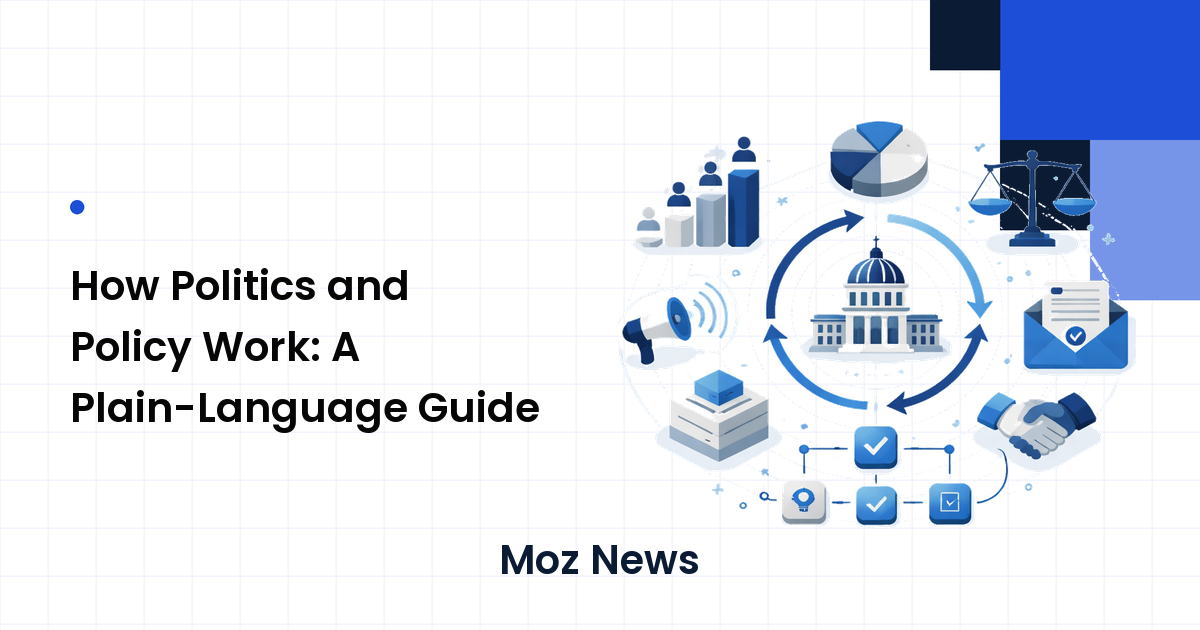
Political news is loud, fast, and often framed to make you pick a side before you understand the substance. Beneath the noise, though, there is a fairly orderly machine: decisions get proposed, debated, decided, and carried out through processes that are mostly the same from one issue to the next. Understanding that machine is the difference between reacting to headlines and actually following what is happening. This guide explains, in plain language and without taking sides, how politics and policy work — and how to follow them with a clear head.
The short version: politics is the contest over who gets to decide; policy is the decision itself and how it is carried out. Keep those two apart, learn the basic path a decision travels, and most political news becomes far easier to read.
Politics vs. policy: two different things
People use these words interchangeably, but they describe different stages, and confusing them is the source of a lot of muddled coverage.
- Politics is the contest for power and influence: campaigns, elections, party strategy, negotiation, and the jostling over who gets to make decisions. It is about who decides and how they win or keep the authority to do so.
- Policy is the substance: the actual rules, laws, budgets, and programs that affect daily life — taxes, healthcare, schools, transport, the environment. It is about what is decided and what it does.
A single news story usually contains both. "A party gains seats in an election" is politics. "A new law changes how much tax you pay" is policy. When you read political news, a useful first move is to ask: is this story about the contest for power, or about a decision that changes something real? Often the headline is about the contest, while the part that affects your life is the policy buried further down.
Who actually makes decisions
Systems differ from country to country, but most representative democracies share the same broad division of labor. Knowing which part does what tells you who is responsible for a given decision.
- The legislature (parliament, congress, assembly) debates and passes laws and approves budgets. Its members are usually elected to represent areas or populations.
- The executive (a president, prime minister, government, and the departments beneath them) proposes and carries out laws, runs public services, and handles day-to-day governing.
- The judiciary (the courts) interprets laws and rules on whether actions follow them. It does not write policy, but its rulings can shape how policy works in practice.
Many systems deliberately split power across these branches so that no single one can act unchecked. That design is also why change is often slower than headlines imply: a proposal frequently needs agreement across more than one body before it becomes real.
Layered on top is the level of government involved — local, regional, or national. A frustration blamed on "the government" may actually sit with a city council, a regional authority, or a national department. Identifying the right level is half of understanding who can fix a problem.
How a decision becomes a policy
Most policy travels a recognizable path from idea to effect. The exact steps vary by system, but the stages rarely do.
- An idea or problem rises up the agenda — through a campaign promise, public pressure, a crisis, expert advice, or lobbying by interested groups.
- A proposal is drafted — often as a bill (a proposed law) or a budget measure, with specific wording that will be argued over closely.
- It is debated and amended — in committees and in the wider legislature, where it can be changed, delayed, or blocked.
- A vote decides it — and in many systems it must pass more than one chamber or stage to advance.
- It is approved and enacted — signed into law or formally adopted, sometimes after a final sign-off by a head of state.
- It is implemented — turned into real programs, rules, and spending by government departments, which is where a policy succeeds or fails in practice.
The implementation stage matters more than coverage usually suggests. A law that passes with great fanfare can change little if it is poorly funded or weakly enforced; a quiet rule change can have large effects. When you follow a policy, do not stop at "it passed" — watch what actually happens next.
What elections do, and what they do not
Elections are the headline event of politics, but it helps to be precise about their role. An election decides who holds decision-making power for a period of time. It does not, by itself, decide most individual policies. Those are worked out afterward, through the legislative process above, often involving negotiation and compromise that look quite different from campaign slogans.
That gap between campaign promises and enacted policy is normal, not necessarily a betrayal: proposals get changed by negotiation, by what is affordable, and by what can win enough votes to pass. A clear-eyed reader treats a manifesto as a statement of intent, then watches the slower process of whether and how it becomes real.
How to follow politics and policy without the spin
Political coverage is especially prone to framing, because so much of it is contested. A few habits keep you oriented. (For the wider skill set, our guide on how to read the news critically goes deeper.)
- Separate the reporting from the analysis. What happened (a bill passed, a figure was released) is reporting. What it means or who benefits is analysis or opinion — valuable, but a different thing. Responsible outlets label which is which; tag each sentence in your head as fact or judgment.
- Find the actual decision. Strip away the personalities and the contest, and ask what concrete change is on the table. The substance is often less dramatic, and more important, than the conflict around it.
- Watch loaded language. Words like "slammed," "caved," or "rammed through" carry judgment. Ask what a neutral description of the same event would be.
- Compare across outlets. Reading how sources with different leanings cover the same vote shows you which facts are agreed (usually solid) and where interpretation takes over (the gap between them).
- Be hardest on news you want to believe. The bias most likely to mislead you is your own. Scrutinize the story that flatters your side as carefully as the one that challenges it.
A quick way to read any political story
- Is this about politics (the contest) or policy (the decision)?
- What is the actual change being proposed or made?
- Who decides it, and at which level of government?
- What stage is it at — proposed, voted, enacted, or implemented?
- Which parts are reported fact, and which are interpretation?
- Does a second, independent source confirm the key facts?
FAQ
What is the difference between politics and policy?
Politics is the contest over who holds power — campaigns, elections, and party strategy. Policy is the substance of what gets decided: the laws, budgets, and programs that affect daily life. A single story often contains both, so separating them makes coverage much clearer.
How does a bill become a law?
Broadly, an idea is drafted into a bill, debated and amended in the legislature, voted on (often at more than one stage or in more than one chamber), then formally enacted and signed. Finally it is implemented by government departments. The details vary by country, but the sequence of propose, debate, vote, enact, and implement is common.
Why don't politicians always keep their campaign promises?
Promises are statements of intent made before the slower work of governing begins. Turning a promise into policy requires drafting, negotiation, enough votes to pass, and a budget to fund it — and any of those can change or block it. The gap is often the normal result of compromise rather than deliberate deception, though readers are right to track it.
How can I follow policy news without getting caught up in partisan spin?
Separate reporting (what happened) from analysis (what it means), focus on the actual decision rather than the personalities, notice loaded language, and compare how outlets with different leanings cover the same event. Treat the facts they agree on as solid and the gaps between them as interpretation.
What is the difference between local and national government?
They operate at different levels and handle different things. Local government typically manages services close to home, such as roads, refuse, and local planning, while national government handles country-wide matters like defense, national taxation, and major legislation. Many issues blamed on "the government" actually sit at a specific level, so identifying the right one matters.
Read the decision, not just the drama
Political news makes more sense once you separate the contest for power from the decisions being made, learn the path a policy travels from idea to implementation, and keep reporting apart from opinion. Next time a political story breaks, do the same: ask what the actual decision is, who makes it, what stage it has reached, and what it would change for everyday life. The drama will still be there — but you will be reading past it to the part that matters.