When you open a feed, it feels like a window on the world — the day's news, sorted for you. It isn't. What you see is the output of a ranking system whose real goal is to predict which posts will keep you watching, tapping, and coming back. Understanding how news algorithms work is the difference between reading your feed as the news and reading it as a guess — because "relevant to your interests" and "important to understand" are not the same thing, and the gap between them shapes your picture of the world.
The takeaway up front: a recommendation algorithm is an automated editor optimized for engagement, not accuracy or balance. It doesn't decide what's true or what matters — it predicts what will hold your attention, based on what you and similar users reacted to before. That one fact explains the filter bubble, why you keep seeing "one side," and why outrage spreads faster than nuance. The fix isn't to quit the internet; it's to read your feed as a curated guess and add a few habits the algorithm can't make for you.
What a feed algorithm is actually optimizing for
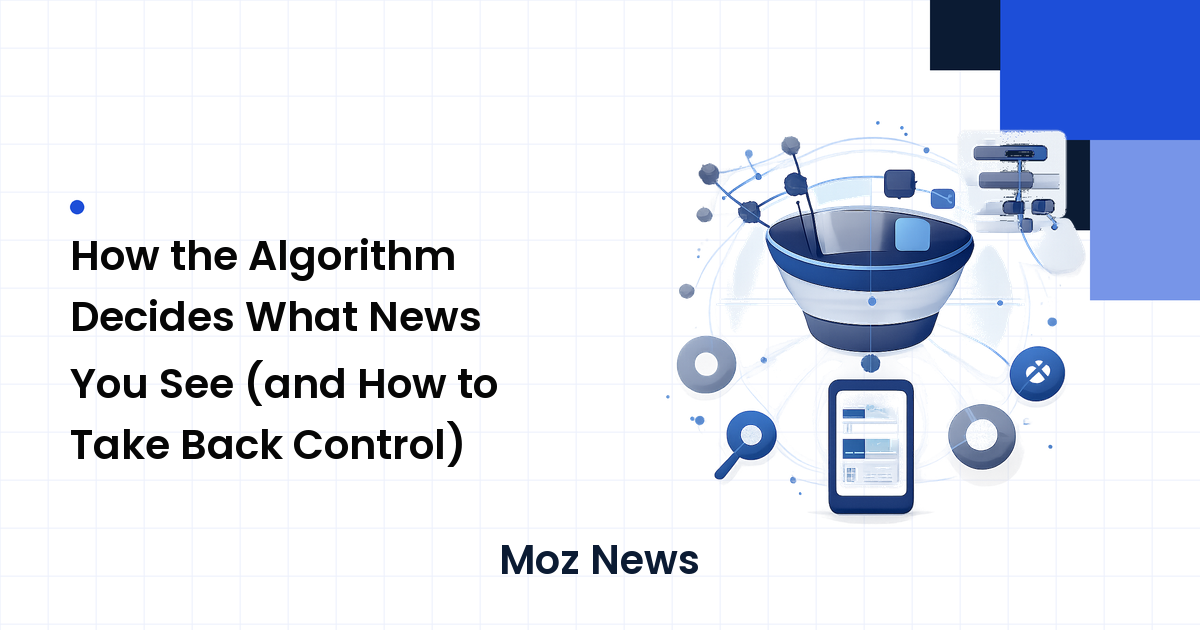
A recommendation algorithm (often just "the algorithm") is the software that decides the order of what you see and what gets left out. On most platforms it has replaced the old reverse-chronological feed — newest on top — with a ranked feed: every candidate post gets a predicted score, and the highest scores appear first. This is the heart of news feed ranking, and the crucial detail is what that score predicts. Not "how accurate is this" or "how important is this story," but engagement — the chance you'll stop scrolling, watch to the end, react, or share — because attention is what platforms sell to advertisers. None of this requires bad intent; it's the natural result of grading a feed on attention rather than understanding. The honest description of your feed, then, isn't "today's news" but "the posts a model guessed would keep you engaged longest" — fine for entertainment, but for news it introduces a bias that has nothing to do with politics.
Why ranking-for-attention narrows what you see
Knowing the goal is engagement, the side effects follow.
- It learns from your reactions, then doubles down. Every tap, dwell, and follow is a signal. Linger on one kind of story and the model infers you want more — and obliges. Over time the feed converges on a narrower slice of topics and viewpoints, because that's what your behavior "rewarded." This is the engine of the filter bubble: a personalized information environment that keeps reflecting your existing interests back at you.
- Emotional content outranks measured content. Posts that trigger strong feelings — outrage, fear, tribal agreement — earn more reactions, so the model scores them higher, while calm, carefully-caveated reporting tends to sink. It isn't a conspiracy to suppress nuance; nuance is simply less engaging by the metric being optimized.
- Confirmation gets rewarded over challenge. You're likelier to react to what fits your existing beliefs, so the system serves more of it — which is why a feed can feel like it agrees with you about everything, while the people in your replies seem to live in a different reality.
- Engagement and importance diverge. A consequential but dry story — a policy change, an economic report — may never surface, while a trivial-but-emotive clip dominates the day. For staying informed, the feed optimizes the wrong target.
Together these explain the complaint "why am I only seeing one side?" Usually it isn't deliberate censorship — it's a system trained on your own attention, narrowing the aperture one tap at a time.
How to take back control of your feed
You can't see the ranking model or switch it off on most platforms. But you have more leverage than it feels, because the same signals that train it against your interests can be redirected. Treat this as adjusting an editor you can't fire, not defeating it.
- Switch to a chronological or "following" feed where one exists. Several platforms still offer a reverse-chronological or follows-only view in the settings. It isn't perfectly neutral, but it removes the engagement-ranking layer and shows what the accounts you chose actually posted, in order.
- Curate your inputs deliberately. The highest-leverage move is choosing who you follow, since that's the candidate pool the algorithm draws from. Intentionally follow a few credible sources across the spectrum and outside your usual topics — you're widening the bubble at its source.
- Be careful what you reward. Hate-watching, rage-replying, and lingering on outrage are all engagement — the model can't tell "I love this" from "I can't look away," and serves more of whatever you dwell on. Scroll past what you don't want more of instead of reacting to it.
- Use the platform's "not interested" and mute tools. "Show fewer posts like this," topic mutes, and unfollows are direct signals back to the ranker — blunt, but among the few explicit dials you have.
- Get news on purpose, not just by ambient feed. Go to a source — a newsletter, an outlet's front page, a news app — at least some of the time, so part of your information diet isn't chosen by an attention model at all. A front page reflects an editor's judgment of importance; a feed reflects a model's judgment of stickiness. Use both, knowingly.
None of these "beat" the algorithm; they change what it works with and keep it from being your only path to the news. And whatever surfaces, the deeper skill is reading it well — checking who reported it, what they claim, and whether a second source agrees, as our guide on how to read the news lays out.
A quick note on AI-powered feeds
Feeds increasingly lean on machine-learning models — often branded as "AI" — to predict engagement and even generate or summarize content. This doesn't change the core logic: the system is still optimizing for a target, and on commercial platforms that target is overwhelmingly attention. "AI-powered" describes the method, not a promise of balance — and a more capable model just gets better at holding your attention, not at telling you what matters.
FAQ
How do social media algorithms decide what I see?
They score every candidate post for predicted engagement — the likelihood you'll stop, watch, react, or share — using signals from your past behavior and from similar users, then show the highest-scoring posts first. The goal is to maximize attention, not to rank stories by accuracy or importance, so a feed is best read as a personalized guess about what will hold you rather than an objective summary of the news.
What is a filter bubble, in plain terms?
The narrowed information environment that results when an algorithm keeps showing you content matched to your inferred interests and existing views. Because it learns from what you react to and serves more of the same, you're gradually offered less that challenges or surprises you — not necessarily deliberate censorship, but the predictable side effect of a system trained on your attention.
Why do I keep seeing only one side of an issue?
Usually because the algorithm has learned which content holds your attention, and confirming or emotionally charged posts tend to do that best — so it serves more of them. People who disagree often see the opposite, for the same reason. The fix is to change the inputs: deliberately follow credible sources across the spectrum, and stop rewarding outrage with your attention.
Is a chronological feed better than an algorithmic one?
For staying broadly informed it has one clear advantage: it shows what the accounts you chose actually posted, in order, with no engagement-ranking layer deciding for you. It isn't perfectly neutral — your follow list still shapes it — but it's a useful default to pair with going directly to a few trusted sources.
Next step
Your feed is an editor you didn't hire, optimizing for your attention rather than your understanding — and once you see it that way, it stops being invisible. Next time your feed feels like the whole story, treat it as one editor's guess: open something you didn't get from the algorithm, and ask who chose what you just saw. For more on reading the news with a clear head, start at moz-news.com.