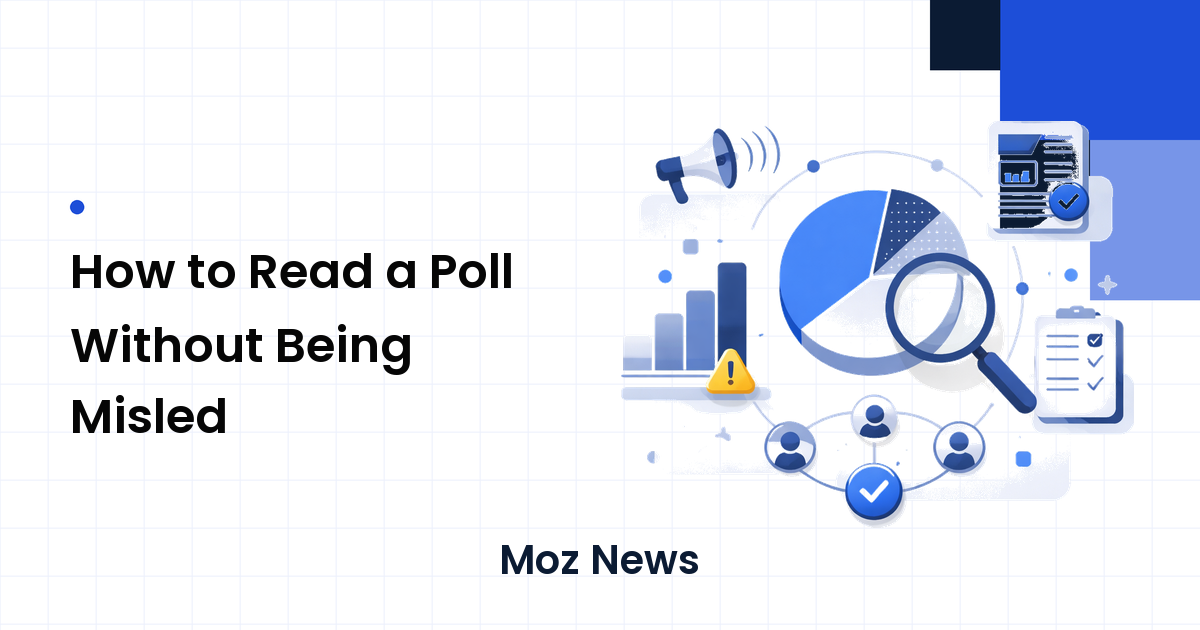
A new poll lands, a headline announces who's "winning" or what "the country thinks," and the number gets repeated everywhere as if it were a measured fact like the temperature. It isn't. A poll is an estimate built from a sample, wrapped in uncertainty and shaped by choices the headline never shows you. Read it as a hard fact and you'll be misled — not because the pollster lied, but because the format hides the caveats.
The takeaway up front: a poll is a snapshot of a sample at one moment, not a prediction and not a fact about everyone. Knowing how to read a poll takes no statistics training — just four plain questions before you trust the number: who was asked, how many, what exactly were they asked, and who paid. Understanding poll results comes down to those questions, the one concept (margin of error) that trips up almost everyone, and a quick way to spot a junk poll.
A poll is a snapshot, not a prediction
The most useful mental shift is to stop reading polls as forecasts. A poll measures opinion at the time it was taken, among the group it reached — it doesn't tell you what will happen later. When a result "turns out wrong" after an election, the poll often wasn't wrong about the moment it captured; opinion moved, or the sample didn't match who actually showed up. The honest version of "a new poll says X" is "one sample, on one set of dates, leaned X — within a range."
The four questions to ask before you trust any poll
Reputable pollsters publish the details that let you judge their work, so whether these answers are present is a strong signal of quality.
1. Who was asked? (the sample)
A poll is only as good as the group it sampled. A serious poll aims for a sample that resembles the larger population — the right mix of ages, regions, and backgrounds. A random, representative sample is the gold standard; a self-selected "click here to vote" poll measures only who happened to click, not public opinion. Watch, too, for the gap between the broad public and a subgroup: "adults" and "likely voters" can produce very different numbers from the same questions, and a result about one is routinely reported as if it were about the other.
2. How many were asked? (sample size)
Sample size drives precision, but the relationship surprises people: beyond a point, bigger samples help less than you'd expect. A well-drawn national poll of around a thousand people can be reasonably precise; a poll of fifty tells you almost nothing, however confident the headline. Beware, too, of a big total hiding a tiny subgroup — a poll of 1,200 might base a dramatic claim about one demographic on the 40 people who fell into that group.
3. What exactly were they asked? (question wording)
How a question is worded can change the answer more than any real shift in opinion. Leading phrasing, loaded words, and even question order all nudge responses. "Do you support common-sense reform?" and "Do you support the proposed change to the law?" are about the same policy and will get different numbers. That's why exact wording matters, and why good pollsters publish it. If a poll won't show you the question it asked, treat it as unproven.
4. Who paid for it, and who ran it? (sponsor and method)
A poll commissioned by a campaign, company, or advocacy group to promote its own position isn't automatically false, but it has an interest in a particular result — and that interest can shape question wording, timing, and which findings get publicized. Independent polls with a public track record and transparent methods earn more trust for those reasons. When you can't find who funded a poll, treat that as a flag.
Margin of error: the one number people read wrong
The margin of error is the most important detail in any poll and the most misunderstood. It's the built-in acknowledgment that a sample isn't the whole population, so the true figure is a range, not the single number in the headline.
Say a poll reports 48% with a margin of plus or minus 3 points. That doesn't mean "48%" — it means the real figure is most likely between roughly 45% and 51%. Two consequences follow, and missing them is how smart readers get fooled:
- A "lead" inside the margin of error may not be a lead at all. If one option sits at 48% and another at 46% with a margin of plus or minus 3, they overlap — the poll cannot confidently say which is ahead. Reporting that as "X leads Y" overstates the data; it's sometimes called a statistical tie. The margin applies to each figure, so small gaps between two numbers are shakier still.
One caveat the margin does not cover: it describes only random sampling error. It says nothing about a skewed sample, bad question wording, or people not answering honestly — so the true uncertainty is always at least the stated margin, often more. A neat "plus or minus 3" can give false comfort.
How to spot a junk poll in seconds
Most low-quality polls give themselves away on one of these:
- No methodology published — no sample size, dates, margin of error, or question wording. A serious pollster discloses these, so their absence is the loudest warning.
- A self-selected "online poll." A "vote in our poll" widget or social-media tally measures enthusiasm among a site's audience, not public opinion — no representative sample, no valid margin of error.
- A leading question or a hidden, interested sponsor — wording that's doing the persuading, or a result promoted by the very group it flatters with no independent source.
- A push poll, which isn't a poll at all but persuasion disguised as research — loaded "questions" designed to plant an idea, not gather one.
When you can, look at the average of several polls rather than any single one, and favor pollsters with a transparent track record. For the wider habits this fits into, see how to read the news critically.
FAQ
Are polls accurate?
A well-run poll is usually a reasonable estimate of opinion at the moment it was taken, within its margin of error — not a precise prediction of the future. Accuracy depends on a representative sample, neutral wording, and honest answers. Any single poll can miss; an average of several reputable polls is more reliable.
Why do different polls show different results?
Mostly because they made different choices: who they sampled (adults vs. likely voters), how questions were worded, when they ran, and how they reached people. Some difference is just random variation within each margin of error. That's why looking at several polls together beats trusting one.
What is a push poll?
A push poll is not real research — it's persuasion dressed as a survey. Instead of measuring opinion, it asks loaded "questions" designed to plant a negative idea in the respondent's mind. Its aim is to spread a message under cover of polling, so its "results" are meaningless as data.
How big does a poll's sample need to be?
There's no magic number, but a well-drawn national poll of roughly a thousand people can be reasonably precise, and going much larger helps only modestly. Far more important than raw size is whether the sample is representative. Be wary of claims drawn from tiny samples, or from a subgroup buried inside a larger poll.
Read the range, not the headline
A poll is a useful snapshot when you read it for what it is: an estimate, from a sample, at one moment, inside a margin of error. Ask who was asked, how many, exactly what they were asked, and who paid — then read the result as a range rather than a fact, and never let a single poll carry the weight of a trend. Do that and polls become genuinely informative instead of misleading. Next poll that makes a headline, run the five-second check first. For more habits that turn the daily flood of news into something you can navigate with confidence, explore Moz News at https://moz-news.com.